Packing your bags and relocating to a new city is one of the most exhilarating decisions you can make. If your chosen destination is Madrid, excitement is absolutely guaranteed: a near-permanent blue sky, an inexhaustible gastronomic scene, and that magnetic energy flowing through Gran Vía at any hour of the day.
However, behind the tourist postcards and the initial honeymoon phase of your first few days, there lies a subterranean reality made of subtle social codes, surprising schedules, and unwritten rules.
Many expats land at Barajas Airport thinking that the only real hurdle they will face is navigating the legal paperwork, securing a NIE, or opening a local bank account. The real surprise comes when they realize that the true challenge isn’t legal—it’s social.
The process of adapting to local behaviors can cause a minor system short-circuit if you don’t understand the dynamics of the capital beforehand.
To ensure your landing is as smooth as possible and to help you transition from feeling like a tourist to living like a local in record time, we analyze the culture shock moving to Madrid through ten everyday realities that nobody shares in official travel guides.
The culture shock of moving to Madrid
Culture Shock at a Glance: Myths vs. Realities
To quickly understand how daily routines shift when settling down in the Spanish capital, this summary table outlines the most shocking dynamics for newcomers:
| What you expect (The Myth) | What you actually find (The Reality) | Impact on Daily Life |
| Homes are built for hosting guests. | Homes are private spaces; social life happens at the bar. | Your living room moves to the corner outdoor terrace. |
| Business schedules follow European standards. | Lunches at 2:30 PM and dinners at 10:00 PM. | You must recalibrate your biological clock and work rhythms. |
| Personal space boundaries are standard. | Conversations are close, highly expressive, and direct. | It can feel like an invasion at first, but it represents warmth. |
| Apartment buildings are perfectly quiet. | Historic structures where you hear the pulse of the block. | Living together requires understanding neighborhood codes. |
Life Happens in the Street (Socializing & Terrace Culture)
The first major impact an expat experiences when analyzing the Madrid lifestyle and customs is the absolute conquest of public spaces. In many Anglo-Saxon or Northern European cultures, the home is the neurological hub for socializing: you invite friends over for dinner, host backyard barbecues, or open the doors of family intimacy to celebrate milestones.
In Madrid, this is simply not the norm.
1. The corner bar is your actual living room
Except for very rare occasions or intimate family milestones, apartments in central Madrid are normally reserved for the immediate family nucleus or absolute privacy.
Does this mean Madrileños are uninviting? On the contrary. They are hyper-social, but their designated meeting point is the local bar, the tavern, or the public square.
Learning how to socialize in Madrid implies accepting that the bartender downstairs will eventually know your name, your morning order, and your daily routine. The bar functions as a direct extension of the house: it’s where locals debate politics, celebrate promotions, process breakups, and spend Sunday mornings reading the newspaper over a coffee or a crisp caña.
2. The sacred Madrid terrace culture
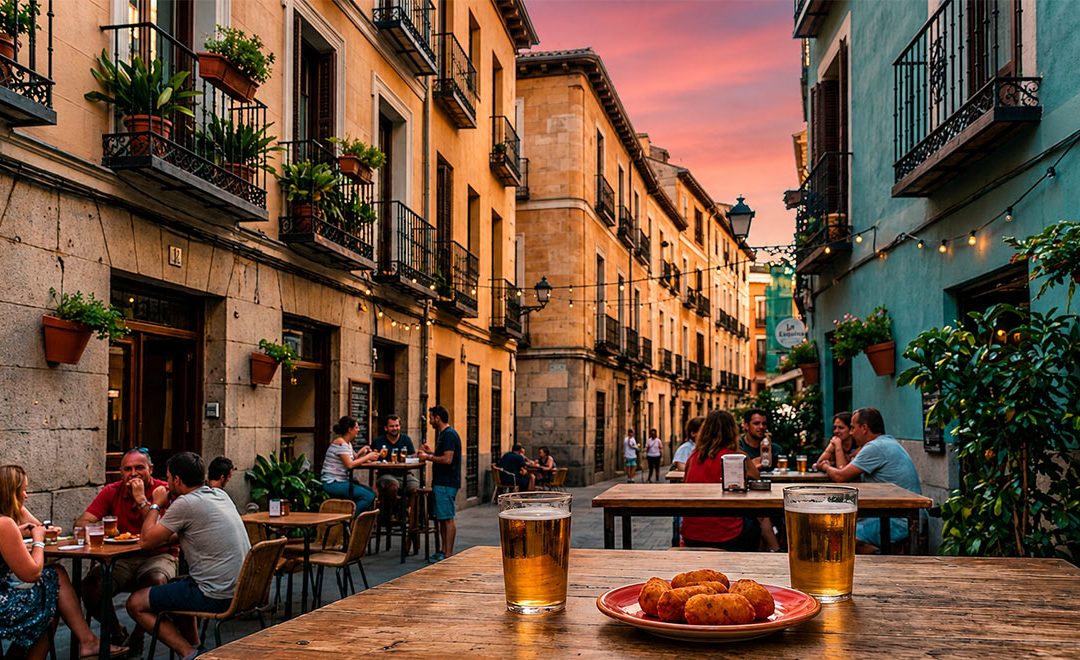
It does not matter if it is August at 38°C in the shade or January with temperatures hovering near freezing; if there is a single ray of sunlight peeking through, outdoor tables will be packed to capacity.
The vibrant Madrid terrace culture is practically a religion. Dining inside a restaurant is often perceived as a backup plan. Being outside, watching people walk by, and soaking in the ambient chatter of the street is an indispensable component of the local experience. If you are meeting someone, expect the conversation to start with: “Shall we find a table outside?”
3. “Cañeo” and the art of endless sharing
In other global capitals, going out for a drink involves sitting down, ordering a heavy individual beverage, and perhaps getting a main course all to yourself. In Madrid, people practice cañeo (moving from bar to bar for small beers) and tapeo. Portions (raciones) are placed right in the center of the table and shared communally. Keeping a plate entirely to yourself is considered socially awkward. Furthermore, the rhythm is fluid: it is entirely normal to grab a quick drink at one spot, eat a croquette, and immediately move to the next venue for a plate of bravas. The night transforms into a dynamic, progressive journey.
The Codes of Daily Life (Local Customs & Rhythms)
Once you navigate the bar scene, the next level of culture shock moving to Madrid is found in interpersonal communication and time management. This is the realm where subtle nuances are most easily misinterpreted by newly arrived expats.
4. High volume and reduced personal space
If you step into a Madrileño cafeteria at ten in the morning, you might initially assume everyone is locked in an intense argument. They aren’t: they are simply talking. The local volume level is significantly higher than what you might be used to in Anglo-Saxon or Asian countries.
On top of that, physical distance during conversations is notably shorter. Locals gesticulate heavily, touch your arm to emphasize a point, and maintain intense, direct eye contact. If you are wondering are people in Madrid friendly to foreigners, the answer is a resounding yes: they aren’t invading your personal space; they are showing genuine warmth, engagement, and immediate trust.
5. Shifted schedules and the mystery of the late afternoon
Your biological clock is about to undergo a radical restructuring. Trying to have lunch before 2:00 PM is a nearly impossible mission in local restaurants, and sitting down for dinner at 8:00 PM will instantly brand you as a tourist (many kitchens haven’t even turned on their stoves by then).
Traditional local customs in Madrid Spain dictate that dinner unfolds between 9:30 PM and 11:00 PM. Additionally, there is a distinct transitional pocket between 5:00 PM and 8:00 PM where the city’s business rhythm slows down slightly before exploding into nightlife. Adjusting to this unique daily schedule and rhythm of life in Madrid is a rite of passage for every expat.
6. The elasticity of time: “Ahora mismo” vs. Real time
Punctuality in social settings carries a wonderful (or frustrating, depending on your perspective) elasticity. If you arrange to meet someone at 8:00 PM, arriving at 8:15 PM falls completely within the boundaries of acceptable behavior. No one will be offended, and no dramatic explanations are expected. Time is measured more by the enjoyment of the shared moment than by the rigid ticking of the clock.
House Rules (Convivience & Apartment Communities)
When you finally close the door to your rental apartment and think you are safe from the surprises of the outside world, you quickly discover that domestic life in the capital operates under its own distinct set of rules.
7. Living in an apartment building in Madrid: Thin walls, thick history
A vast portion of the real estate landscape in central Madrid (such as Malasaña, Chamberí, or La Latina) consists of buildings dating back to the late 19th or early 20th centuries. They possess undeniable historical charm, featuring high ceilings and exposed wooden beams, but their acoustic insulation is often limited.
Living in an apartment building in Madrid means accepting that you will hear the footsteps of the neighbor upstairs, the television to your right, and conversations echoing through the inner courtyard (patio de luces). Far from being a source of constant conflict, locals have developed a high natural tolerance for everyday background noise. Coexistence is built on accepting the soundtrack of each other’s lives, provided standard nighttime rest hours are respected.
[Relative Silence / Rest Hours] —> 11:00 PM to 8:00 AM (Standard regulation)
[Daily Routine / Domestic Activity] —> 8:00 AM to 11:00 PM
8. The community president and neighborhood assemblies
In many countries, building management is outsourced entirely to an external corporation, and tenants or owners never see each other’s faces. In Madrid, the figure of the Presidente de la Comunidad (a mandatory, rotating role among property owners) remains incredibly relevant. Annual neighborhood meetings can turn into arenas of pure magical realism, where everything from the budget for a new elevator to the specific color of the building’s main doormat is fiercely debated. Understanding these Madrid apartment rental rules and social frameworks will make your integration much simpler.
9. Waste management and communal responsibilities
A detail that routinely catches expats off guard is trash collection. Many historic buildings in the city center do not have permanent dumpsters inside the property. Instead, specific trash bins are rolled out onto the street by the building porter or designated neighbor starting at 8:00 PM, and municipal trucks collect them overnight. Leaving your trash out during the day or failing to sort recyclables properly can result in strict complaints from neighbors or unexpected municipal fines.
10. Having a pet in Madrid: Tips for dog owners
Madrid genuinely loves dogs. You will see outdoor terraces packed with pets and designated green zones (like El Retiro or Madrid Río) featuring spectacular off-leash play areas. However, if you are looking into having a pet in Madrid tips, your first step should be a meticulous review of your rental lease. Many traditional landlords remain highly hesitant to accept animals in apartments with historic, original hardwood floors (parqué), making the house hunt slightly more competitive for pet owners.
Frequently Asked Questions (FAQ)
Is it true that shops in Madrid completely close during the afternoon for a siesta?
This is mostly a myth in modern times. Major retail chains, supermarkets, and shopping malls in the center of Madrid remain open continuously from 10:00 AM to 9:00 PM or 10:00 PM. However, traditional neighborhood businesses (such as locksmiths, cobblers, family-run pharmacies, or specialized local boutiques) still maintain a split schedule: they close between 2:00 PM and 5:00 PM for lunch and rest, reopen in the late afternoon, and close for the day around 8:30 PM or 9:00 PM.
How should I greet someone I am meeting for the first time in an informal setting?
In social or informal environments, the standard greeting between women, or between a man and a woman, consists of two light kisses on the cheeks (always starting on the right cheek). Between men who do not know each other well, a firm handshake is the standard protocol. In professional business environments, a handshake remains the universal norm across all profiles.
Is tipping mandatory in bars and restaurants across Madrid?
Tipping is not mandatory, nor is a specific percentage automatically appended to your bill, as service charges are legally included in the price of the food and the staff’s wages. Leaving a tip is entirely voluntary and meant to reward exceptional service. In casual cafes or bars, leaving loose change is common practice. In sit-down restaurants for dinner, leaving 5% to 10% is viewed as an incredibly generous gesture of appreciation.
Master Madrid Before Your Move
Experiencing a bit of culture shock moving to Madrid is completely inevitable, but the speed at which you transform that shock into local familiarity depends entirely on the tools you travel with. Do not let everyday surprises, scheduling mix-ups, or hidden clauses in rental contracts slow down the immense excitement of starting this new chapter.
If you want to bypass the classic mistakes made by 90% of internationals upon arrival, explore our Digital Guides and Specialized Books available directly on our website. Inside, we unpack the real Madrid: from deciphering rental leases without hidden traps to mastering the definitive community coexistence codes, all explained step-by-step by relocation relocation experts.
Secure your copy today, get ahead of the paperwork and local customs, and start navigating the city with the confidence of a true Madrileño.